That was the issue raised at the last meeting of our Mystery Book Club (MBC). I presume it is based on the notion that reading Book #9 without reading Books #1 through #8 would be akin to walking into a movie that has a mystery type of plot… but arriving one hour late. Or similar to watching a 10-episode mystery show on PBS TV (the kind where the inspector struggles with one murder case through the entire series)… but starting with Episode #6.
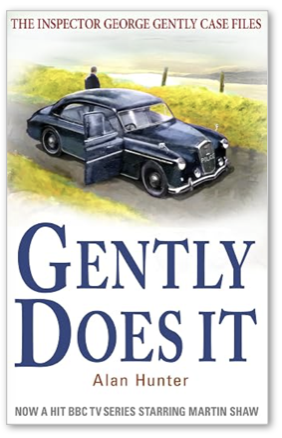
But neither analogy above reflects the reality of a mystery book series. A mystery book series is more like watching a TV series like Blue Bloods, George Gently, or Dragnet: Each episode can be watched in any order because the episode provides everything you need to know to understand and enjoy the story.
Mystery book authors know that a series requires balancing a self-contained puzzle in each book with ongoing character growth across the entire shelf. In each book of the series, good authors must introduce a mystery and solve it completely by the final chapter. They try to write each story so that a new reader can jump in anywhere without feeling lost or needing the previous books.
That being said, some authors change things up to keep it interesting; they can do that by making the lead character(s):
- • grow older in real time from book to book, or not.
- • have romantic relationships that evolve and change, including by deaths, or not.
- • have children that evolve and change, including deaths, or not.
- • experience, in earlier books, lasting injuries, emotional trauma, diseases, changes to their home/office, or not. (Robert Parker’s Spenser changed his PI office address in Boston 3 times during the first 12 books of the 40 book series.)
- • investigate, a little bit in each book, a personal and emotionally difficult mystery/case over many books while still completely solving the main mystery/case of each book, or not.
So, the assumption behind the question is at least partly legitimate: The author may have explained more about the lead character’s background in the first book, and later books may refer to relationships that have changed over the course of several books – so why not start with Book #1? Let’s examine the answer.
Analysis of the five chosen books that are “series” books
First of all, to be clear, two of the five mystery book series this year are Book #1 of the series – because that is always our first choice if at all possible. Those two books are highlighted in green in the list below.
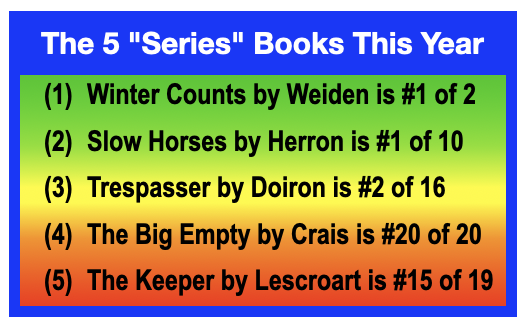
Trespasser is Paul Doiron’s Book #2. That’s because the group read Book #1, The Poacher’s Son, in 2016. Okay, that’s 10 years ago and only 3 regulars were part of the group then. Perhaps we can re-visit this decision in one of our meetings to see if the group prefers to read Book #1 [scheduled for next July]. Feel free to raise this point in a meeting. I don’t mind re-reading this excellent book. I’m leaving it with yellow highlighting for now. (I wouldn’t be suggesting this if the group had read the book 3 years ago. In fact, I am not personally in favor of repeating the same author one or two years later – because there are so many more books in the sea to fry.)
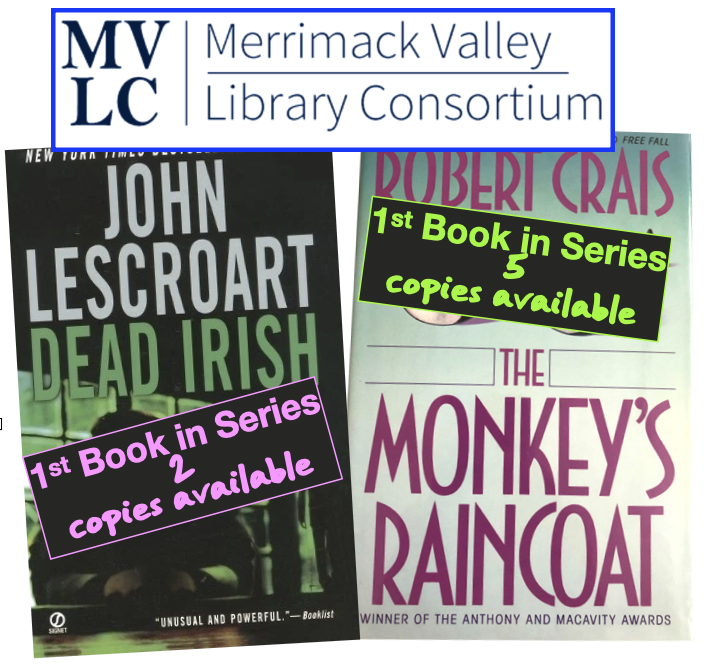
Now let’s look at the two remaining books where some people saw “red.”1 In both cases it comes down to the fact that our library is not likely to be able to make available enough free copies of Book#1 for each participant. The library is dedicated to providing free services to the community and that means that no one should have to spend money buying a book for book club unless that is their own preference. So our club must plan ahead to have available copies for everyone. To do that, our librarians access copies mainly from the 35 other town/city public libraries that make up the Merrimac Valley Library Consortium (MVLC). And for these two mystery book series, MVLC comes up short for Book #1. (10 copies of a print book would be borderline acceptable as some members use audio copies.)
NOTE: A chart below compares the challenges of 5 different book series titles and the number of copies in the MVLC.
The two anomalies; books where we could not choose Book #1
The Big Empty by Robert Crais (Book #20 of 20): This is Crais’s most recent book and it has won him the top two mystery awards for his first time: the 2026 Edgar Award for Best Mystery and the 2026 Thriller Award for Best Series Novel. Yes, it’s pretty major to be among the top 5 or 8 books that make up a “Finalist” for this award. But to be the ONE among thousands published says something important. Both of these awards are determined by fellow members, all of whom must be published authors by acceptable publishing houses to be accepted into membership. Prior to the publication of Book #20, Crais has said that he recommends test-driving his series by reading L. A. Requiem (Book #8). I considered the blurb of both (#8 & #20) and decided to nominate Book #20. If you like Private Investigator Elvis Cole and his ex-Marine sidekick, then you can personally pursue Book #1.
The Keeper by John Lescroart (#152 of 22). There are 22 MVLC copies of Book #15 available. While writing this article I see that we read Book #17 in January, 2025; that must have slipped by me. (As I mentioned earlier, we have generally tried not to repeat an author within at least 3 years of reading one of their books. If the author got a score above 90, that might change the calculus. But the whole purpose of the MBC is to [1] have fun, and [2] meet new crime fiction authors you might personally want to pursue in your own reading.) MVLC cannot support Books #1 through #7. I’m OK with The Keeper.
Why are there so few copies for many authors’ first-of-a-series book?
Why? All libraries gradually thin out (discard) books that have limited or no circulation to make room for buying new books, but especially libraries like ours that have never expanded its original physical building space. The older the publication date of a fiction series book, the more likely it will be tossed.
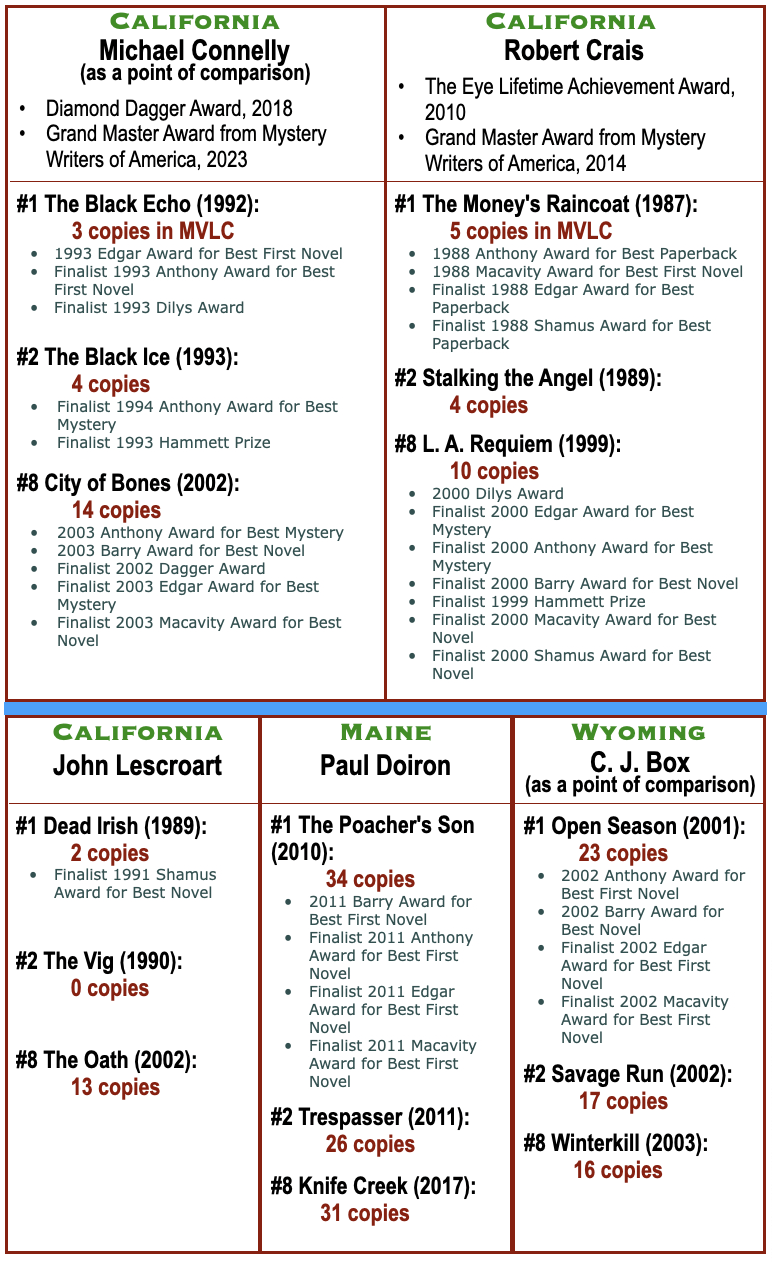
Some Observations:3
1) Does being a “top level” author make any difference (to total copies of their books in the MVLC)? Stephen King has sold a total of 400 million copies world-wide. That is definitely top level. Michael Connelly claims to have sold 92 million copies of his books world-wide.4 That is still very much top level. But here’s the thing: Only 1.1% of all books published by the top 10 American publishers will sell more than 50,000 copies. And 88% of all such books sell less than 1,000 copies.5 To have even half a chance of making a bare living on writing crime fiction, you have to keep at it. No one gets rich on one book.6 [There are untold numbers of authors who have written a handful of great books and given up. But they’re pretty good mysteries! Good examples of Massachusetts’ authors no longer writing their good stories are Mark Arsenault and David Hosp. They each wrote four good books, not best sellers, and then decided the compensation wasn’t worth it.]
Does being top level make a difference? Yes – most of the 35 MVLC libraries will buy at least one, if not multiple copies of very popular, best-selling authors, because the patron-demand will be there for it. But sadly, as the years pass, all those books are mostly discarded to make room for newer books! That’s why there are only 3 copies in the entire MVLC system of The Black Echo, Connelly’s first book published in 1992.
Perhaps the most successful mystery book series ever has sold 300 million copies.7 I read many of them in junior high school and after that. The series had 82 titles. It’s how I got hooked on courtroom dramas. The author was Erle Stanley Gardner. When I first started visiting Manchester Public Library around 1969, there were at least three shelves filled with just these Perry Mason stories. Now there isn’t even one book left. There are about 80 books in the other 34 libraries, but many of those are duplicates, so it is likely that you won’t find all of the books in the Mason series in the MVLC. That’s the future of even top level writers today. Their books will slowly disappear.
2) Does it make a difference if the author‘s first few books win one or more awards? Yes, but not all awards are equally powerful. A Pulitzer Prize would certainly do the trick, but it is not likely it would be awarded to books in the crime fiction category. All of the awards for books in the crime fiction sector are listed on a page in the StopYoureKillingMe.com website. A best book of the year award by the Mystery Writers of America (“the Edgar”), or the Crime Writers’ Association [UK] (“the Dagger”) would be most influential on media. To be a “Finalist” is a great honor in any award, but the actual winner is the one that is most apt to prompt reviews in major newspapers. Of lesser influence are awards by the Malice Domestic conference (“the Agatha”), the International Thriller Writers organization (the “Thriller”), and the Bouchercon conference for mystery fans (the “Anthony”). The rest of the awards are certainly an honor for the author, and somewhat of interest to those active in the crime fiction community, but probably have little impact on the general media.
A good example of this is Michael Connelly. His very first book, The Black Echo, was published in 1992 and received the Edgar Award for Best First Novel by an American Author. That, plus positive reviews, brought the start of national recognition. A thousand other new books did not get that recognition. Plus the fact that President Clinton was carrying his third book through an airport helped too.8 Also, critical to his success at reaching the 1% level in mystery book writing is that he kept writing at roughly the same quality of his first high quality book and now has a catalog of more than 30 novels. And, a really major factor, he has successfully managed to use many of his books as a basis for movies9 and especially the streaming shows on Prime and Netflix all of which helps market more sales of his whole catalog.
3) Does it make a difference if the author lives in New England, in Massachusetts especially? Yes, slightly. It is easier to find copies of a mystery author’s books in the MVLC if they live in our area, and their stories are set in our area. Paul Doiron is a good example. Conversely, fewer or zero copies of Paul’s books will show up in library collaboratives in our western and southern States. Just like many very good books by writers below mid-level will not be available at all in the MVLC if the authors live in Oregon or Kentucky.
Gerry Boyle is another crime writer in Maine. In 2016, we read one of his books and invited him as a guest speaker. He was happy to drive down, speak to our Mystery Book Club, and stay overnight. It would be impossible for our Club to read one of his titles as none of his books has more than 2-5 copies in the MVLC.
In 2023, Bruce Robert Coffin, former Detective Sergeant with the Portland Police Department also visited our Club and spoke with us (at the Masonic Hall). He is still writing and perhaps we could round up 9-10 copies of 3 of his titles in the MVLC.
Earlier I mentioned Boston author David Hosp who wrote only 4 books between 2005-2010, and then stopped writing. Yet there are 8 copies of three of his titles still in MVLC. I’m glad! But I doubt any of his books can be found in a Colorado library.
So yes, local and regional authors have a slight advantage, but not enough to assure enough copies in the MVLC a few years after publication to supply a book group (min. of 10).
Hopefully this helps explain the issues of book availability that impact our choice for books on our reading list. In short, it’s OK to get introduced to a series with any book. Then if you want to delve into it, start at Book #1 and read through.
- Just kidding – I know it was just a question! ↩︎
- The book categorization and thus the book number that SYKM has, differs from the way the author’s website lists the book. I have chosen to use the author’s website as a basis for counting which number the book is for the Dismas Hardy series. ↩︎
- The figure of 350-400 million copies for King is mentioned on many sites like this one. Google the question. ↩︎
- Connelly’s claim is on his website: https://www.michaelconnelly.com/ ↩︎
- These percentages are derived from analysis of BookScan data by Kristen McLean and reported by Jane Friedman on April 26, 2026. ↩︎
- “How Many Books Do You Need to Sell to Make Money?,” by Story Writer, March 20, 2025. ↩︎
- List of Best Selling Book Series with more than 100 million copies sold. ↩︎
- See: “The philandering President who made my fortune: How superfan Bill Clinton helped turn thriller writer Michael Connelly into a literary star,” in the Daily Mirror, Nov 9, 2019. ↩︎
- See: Connelly’s website and check under tabs (1) “TV Series” and (2) Extras ↩︎