Find Extended Answers Below to the Quiz regarding “Mystery Book Publishers and Their Readers”
Do the Quiz Before Reading Further. You have Two Ways to Do the Quiz:
(1) To use an online version of the quiz, CLICK HERE. Or, (2) to get a PDF of the quiz to read and answer with scrap paper or to print out the quiz CLICK HERE.
Do the Quiz Before Reading Further.
Then Scroll Down to the Extended Answers.
THE QUIZ ANSWERS
Question # 1: What book has sold more copies than any other published book? (Fill in the blank. This is an easy one to get you started): ___________________________________
Answer # 1: The Bible! Here are the 15 best-selling individual books, based on total copies sold.1
- The Bible – 5 billion copies sold [Christian Religion]
- The Quran – 3 billion [Muslim Religion]
- The Little Red Book: Quotations from Chairman Mao – 900 million [Maoist Communist Religion]
- Don Quixote – 500 million (First Modern Novel, by Miguel de Cervantes, Spain, first published in two parts – 1605, 1615)
- Selected Articles of Chairman Mao – 450 million [Maoist Communist Religion]
- A Tale of Two Cities – 200 million (Novel by Charles Dickens, England, 1859)
- The Lord of the Rings – 150 million (Novel, by J. R. R. Tolkien, England, 1954)
- Scouting for Boys: An Instruction in Good Citizenship – 150 million ( ?? )
- The Book of Mormon – 150 million [Mormon Religion]
- The Little Prince – 140 million (Novella, by Antoine de Saint-Exupéry, France, in US in 1943)
- Harry Potter and the Sorcerer’s Stone – 120 million (Novel, by J. K. Rowling, England, 1997)
- The Truth that Leads to Eternal Life [Jehovah’s Witnesses Religion] – 107 million
- Alice in Wonderland – 100 million (Novel by Lewis Carroll, England 1865)
- Dream of the Red Chamber – 100 million (Novel by Cao Xueqin, China, 1791)
- The Lion, The Witch and the Wardrobe – 85 million (Novel by C. S. Lewis, England, 1950)
Q # 2: How many copies of a book must an author sell to be “commercially viable.”
- A) 1,500
- B) 5,000
- C) 10,000
- D) 15,000
- E) 20,000
A # 2: B) 5,000 copies. 2
Since indie publishing (or self-publishing) is the author’s own endeavor, there is no advance on account of the future sales of the book (as is the case with traditional publishers). The frightening truth of publishing is that most books do not sell. For a book to be commercially viable, it needs to sell over 5,000 copies, and 86% of books do not achieve this. If your self-published book does not sell, in the best-case scenario, you receive no return on your time investment. Pessimistically, you will suffer financial losses if you invest in editing, book design, marketing or ISBN when your book does not succeed commercially.
Q # 3: In 2023, what per cent of Americans read at least ONE book?
- A) 2% read at least one book
- B) 7% read at least one book
- C) 23% read at least one book
- D) 37% read at least one book
- E) 47% read at least one book
- F) 54% read at least one book
A # 3: F) – 54% read at least one book.
If 54% of Americans read a book in 2023, that means that 46% did not read any books!
Book-reading is strongly associated with college education. 44% of U.S. adult citizens without a college degree said they read at least one book in 2023, compared to 73% of those with a college degree.3
Q # 4: Let’s pretend you were in the Mystery Book Club in 2023 and read all 12 of the books for the year. AND, in addition found time to read 8 more books during the year. That means you read 20 books. AND that would mean that you read more than …. (guess!)
- A) 68% of your fellow Americans.
- B) 74% of your fellow Americans.
- C) 78% of your fellow Americans.
- D) 84% of your fellow Americans.
- E) 88% of your fellow Americans.
- F) 98% of your fellow Americans.
A # 4: E) – If you read 20 books in 2023, you read more books than 88% of other Americans. Here is the complete picture in a table:4
If in 2023 you read or listened to… | …… then you read more than this share of American adult citizens |
| More than 50 books | 99 |
| 40 books | 94 |
| 30 books | 92 |
| 20 books | 88 |
| 15 books | 85 |
| 10 books | 79 |
| 9 books | 78 |
| 8 books | 77 |
| 7 books | 76 |
| 6 books | 72 |
| 5 books | 67 |
| 4 books | 62 |
| 3 books | 56 |
| 2 books | 51 |
| 1 book | 46 |
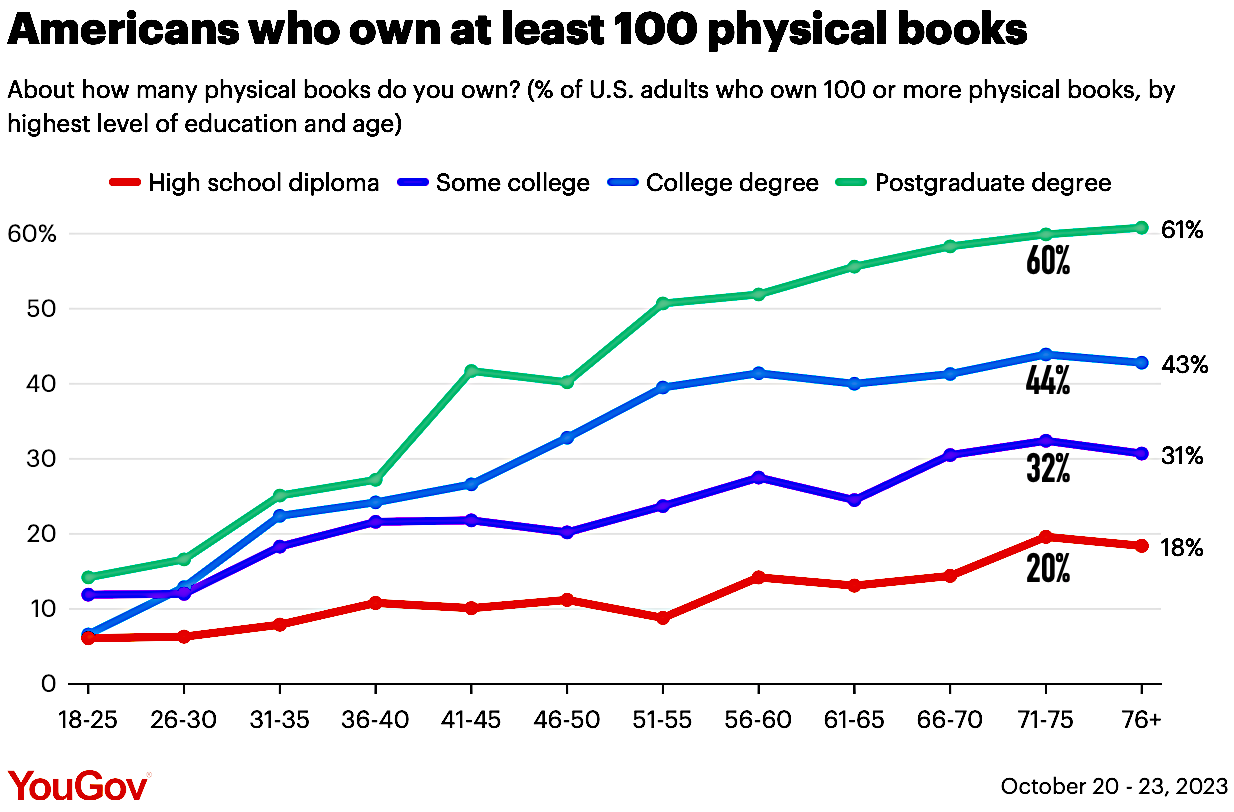
Q # 5: Do you own some books? How many? Let’s get specific, let’s pretend (a) you are between the ages of 71 and 75, that (b) you have a high school diploma and a college degree… how many Americans in that specific demographic do you think have at least 100 physical books of their own? … (guess!)
- A) 24% of Americans 71-75 years old with a college degree own at least 100 physical books.
- B) 34% of Americans 71-75 years old with a college degree own at least 100 physical books.
- C) 44% of Americans 71-75 years old with a college degree own at least 100 physical books.
- D) 54% of Americans 71-75 years old with a college degree own at least 100 physical books.
- E) 64% of Americans 71-75 years old with a college degree own at least 100 physical books.
- F) 74% of Americans 71-75 years old with a college degree own at least 100 physical books.
A # 5: C) – only 44% of Americans 71-75 years old with a college degree own at least 100 physical books. Here is the complete picture in a graph:5
Q # 6: What genre of adult fiction had the most sales in 2022 in the United States (32 million print copies sold)? (in alphabetical order…)
- A) Fantasy Fiction
- B) Historical Fiction
- C) Horror Fiction
- D) Literary Fiction
- E) Mysteries and Thrillers
- F) Romance Fiction
A # 6: F) – Romance Fiction.
Romance is the most popular genre of books sold in the US, achieving over 32 million print copies sold in 2022.6 “Romance consistently stands as one of the top-selling genres, generating around $1.4–1.5 billion annually in the U.S. alone (Romance Writers of America, RWA).”7
Q # 7: Genre-reading by gender: Regarding the Mystery-Thriller (or Crime Fiction) Genre, which statement is true?
- A) Many more men read crime fiction than women.
- B) Many more women read crime fiction than men.
- C) Roughly the same number of men and women read crime fiction
A # 7: B) – Many more women read crime fiction than men.
A blog post by D. Wallace Peach reported data she saw on Statista. The data is based on a 2015 survey of 2,273 US readers. She states, “The survey asked readers to identify the type of books they’ve read in the last year by genre. (Note that this is a survey of interest not volume. So, someone who reads 20 romances and 1 fantasy novel will check both boxes “yes.”) As with all surveys, take this one with a pinch of salt).” Some of the results are shown here:8
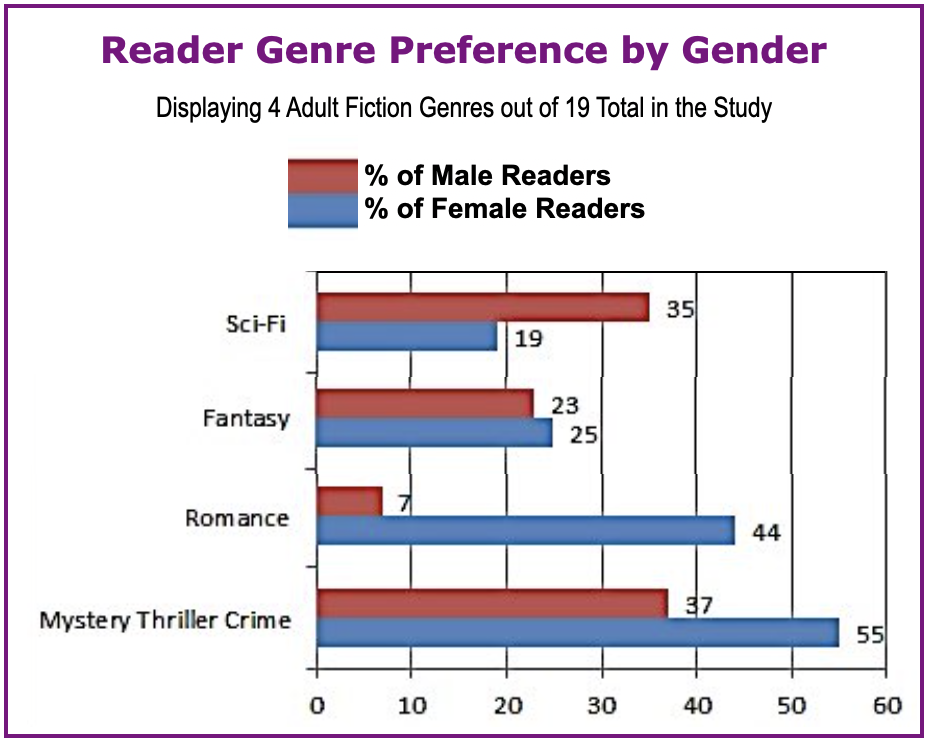
The “Fantasy” genre seems to be the only one without a significant difference. The other three suggest that women are the major readers of “Romance” and “Crime Fiction,” while “Science Fiction” attracts more men.
Many have written expressing opinions about WHY women may read more crime fiction than men, but research such as that from Statista [above] is hard to come by. Here is one author’s thinking on gender in the mystery genre.
One factor is that women read more than men on the whole. And this 2024 post summarizes some research that is available while lamenting that there is not enough hard evidence to be sure.
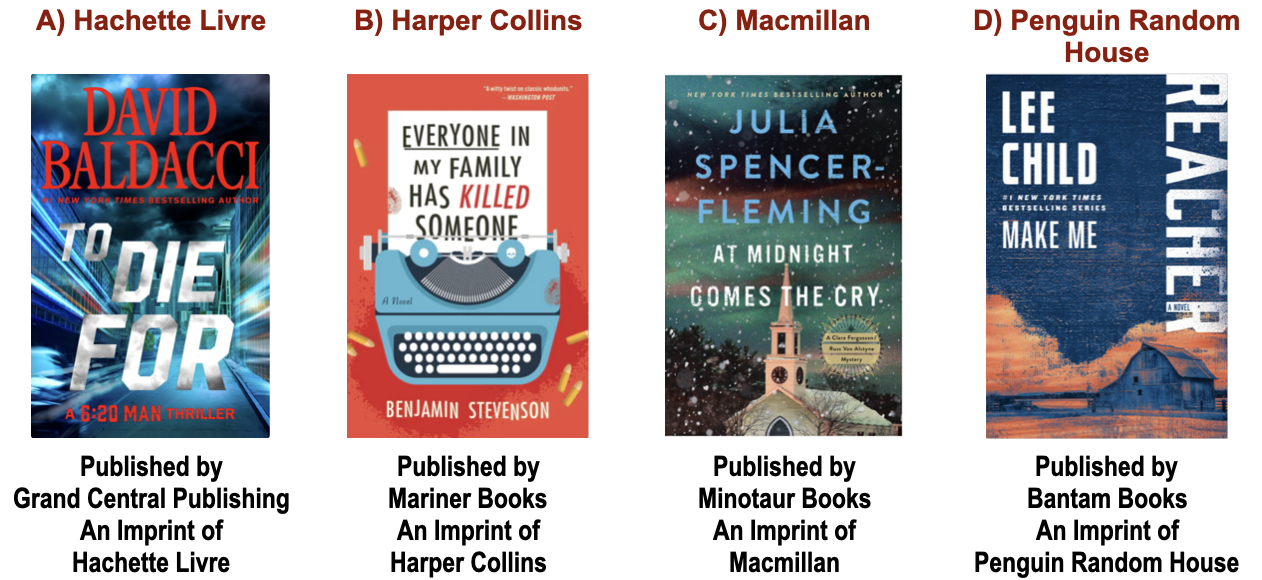
Q # 8: Of the “Big Four” in publishing fiction, which makes the most money? (These publishing behemoths are listed in alphabetical order, with one of their many published crime fiction books, in parentheses.)
- A) Hachette Livre (To Die For by David Baldacci)
- B) Harper Collins (Everyone in My Family Has Killed Someone by Benjamin Stevenson – Our February 2025 Book)
- C) Macmillan (At Midnight Comes the Cry by Julia Spencer-Fleming)
- D) Penguin Random House (Make Me by Lee Child)
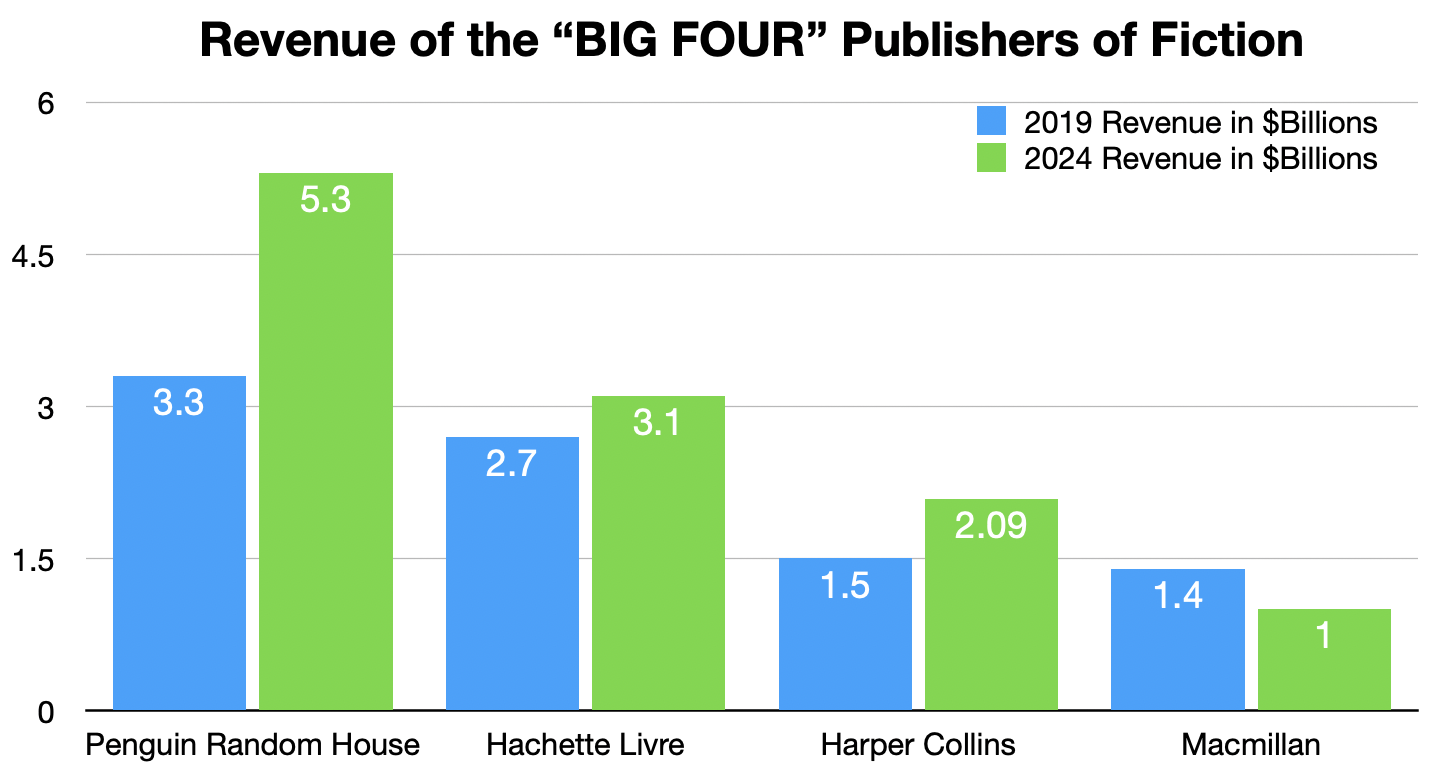
A # 8: D) – Penguin Random House (PRH).
Below is a chart for revenues in the so-called “Big Four” of the publishers that put out books for the general public to purchase and read – as opposed to textbooks, catalogs, and other printed materials. Because Macmillan is not a public company, it is not required to report revenues, so those figures, especially for 2024, are estimates.9
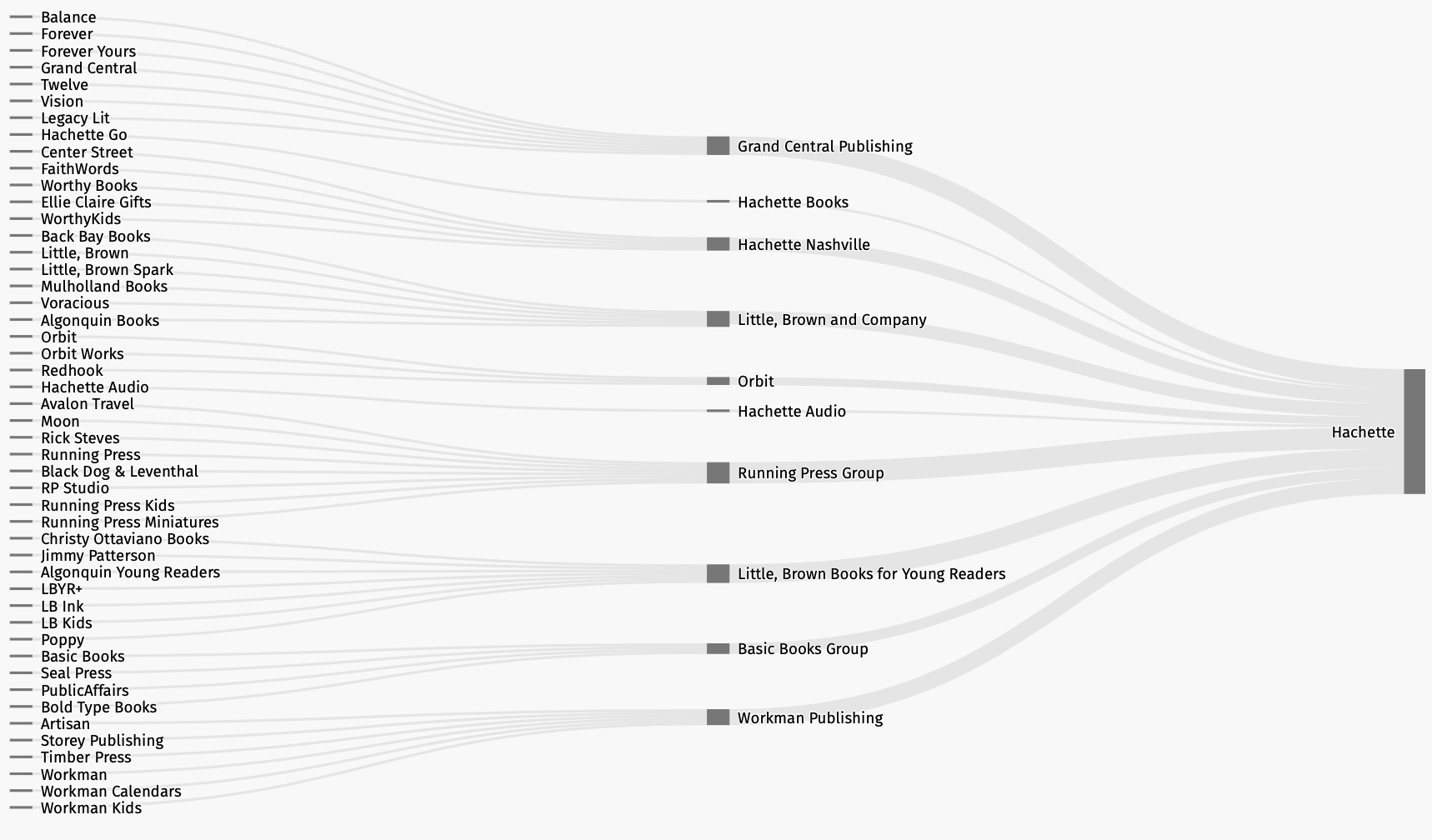
Over many years, through mergers and buy-outs, scores of small publishers became divisions of increasingly larger corporate publishing organizations; they use the quaint term of “imprints” for these divisions. Unsurprisingly, the trend began in 1981.
Here is an example of this “swallowing up” or conversion of independent book publishers into imprints for the Hachette Livre corporation:
Learn more about the imprints and books for each of these companies if you wish:
- Penguin Random House: https://www.penguinrandomhouse.com/imprints/
- Hachette Livre: https://www.hachettebookgroup.com/landing-page/imprints/
- Harper Collins: https://www.harpercollins.com/pages/imprints
- Macmillan: https://us.macmillan.com/about
Each of those mega publishing companies are, in turn, owned by much larger media-oriented, monster corporations:
- Penguin Random House is owned by the privately owned German company, Bertelsmann SE & Co. KGaA. Bertelsmann is an unlisted and capital market-oriented company, which remains primarily controlled by the Mohn family.
- Hachette Livre is owned by Lagardère S.A., an international group with operations in over 40 countries. Based in the 16th arrondissement of Paris, the group was founded and created in 1992 by Jean-Luc Lagardère under the name Matra, Hachette & Lagardère.
- HarperCollins is headquartered in London and New York City and is a subsidiary of News Corp. News Corp., while a public company, has been dominated by Rupert Murdoch and his family. News Corp, like all these companies, has their fingers into many businesses.
- Macmillan is now owned by the German company Holtzbrinck Publishing Group with offices in 41 countries worldwide, since 1999. It also has its fingers into many businesses.
Q # 9: The following quote was created as a guide to authors for a good detective story:
…your detectives shall well and truly detect the crimes presented to them using those wits which it may please you to bestow upon them and not placing reliance on nor making use of Divine Revelation, Feminine Intuition, Mumbo Jumbo, Jiggery-Pokery, Coincidence or Act of God.
Who created the guide and when? (choices are alphabetical by last name)
- A) Raymond Chandler. He wrote those lines as part of an essay he wrote in the December 1944 issue of the The Atlantic Monthly; the essay was titled “The Simple Art of Murder”
- B) Agatha Christie. She wrote those words in her Autobiography in 1958.
- C) Ronald Knox. He wrote those words as one of what he called “The Ten Commandments for Detective Story Writers” in 1929.
- D) Richard Levinson. He was one of two screenwriters for the long-running Columbo TV show. He used the words as part of his remarks when receiving a 1972 Emmy Award for Outstanding Writing Achievement in Drama, for a Columbo Episode entitled, “Death Lends a Hand.”
- E) Edith Ngaio Marsh. She used the words as part of an address to the Arts Council in Christchurch, New Zealand in 1973 in discussing what she and other “Golden Age of Mystery” writers had believed while writing their books.
- F) Dorothy Sayers. She wrote it to be used as an initiation oath for any new authors joining the London Detection Club (about 1928).
A # 9: F) – Dorothy Sayers.
- Wikipedia Article about Raymond Chandler and “The Simple Art of Murder”
- Wikipedia Article about Agatha Christie
- Blogpost Article about Ronald Knox and The 10 Commandments and More on the Commandments
- Wikipedia Article about Ngaio Marsh
- Wikipedia Article about Dorothy Sayers
- Wikipedia Article about The London Detection Club
Q # 10: Does the gender of mystery book authors make a difference in the number of murders that occur in the mystery books they write? Yep, thanks to a mystery fan with skills in statistical analysis we have the answer. Take a guess below, and then read the research she did. What result do you think she discovered to be true?
- A) The average mystery book by a male author has more than twice as many victims as the average mystery book by a female author.
- B) Mystery books by female and male authors have approximately the same number of murder victims on average.
- C) The average mystery book by a female author has more than twice as many victims as the average mystery book by a male author.
A # 10: A) – The average mystery book by a male author has more than twice as many victims as the average mystery book by a female author.
Specifically, the research showed that (a) the average number of murders in a book with a male author was 4.1, and (b) the average number of murders in a book with a female author was 1.9. I encourage you to read her entire report – Statistics of Mystery Novels – here. There are many interesting details. One such was her comparison of some of the fictional book data with actual FBI crime data!
I hope you enjoyed doing the quiz and learning a bit about the mystery of the mystery publishing business. By using the links in the answers above and the footnotes below, you can spend a lot of time – fun time! – on mystery book trivia.
FOOTNOTES / SOURCES
- “20 Book Sales Statistics and Trends for 2025” by NEWPRINT. https://www.newprint.com/blog/book-sales-statistics ↩︎
- “Pros and cons of indie vs traditional publishing” by MAGDA WOJCIK, https://www.mwediting.com/pros-and-cons-of-indie-vs-traditional-publishing/ ↩︎ ↩︎
- “54% of Americans read a book this year” by David Montgomery at YouGov – US, https://today.yougov.com/entertainment/articles/48239-54-percent-of-americans-read-a-book-this-year ↩︎
- See Footnote #3. ↩︎
- “How many books Americans own — and how they organize them” by David Montgomery, at YouGov – US, https://today.yougov.com/society/articles/47712-how-many-books-americans-own-and-how-they-organize-them ↩︎
- “23 Gripping Book Industry Statistics [2023]: How Many Books Were Published in 2022” by Zippia.com. Jun. 27, 2023, https://www.zippia.com/advice/us-book-industry-statistics/ ↩︎
- “Fiction Book Sales Statistics (2025): A Writer’s Guide” by R. R. Noall, https://www.fromwhisperstoroars.com/fiction-book-sales-statistics/ ↩︎
- “Reader Surveys by Genre and Gender” by Myths of the Mirror / D. Wallace Peach,
https://mythsofthemirror.com/2016/07/11/reader-surveys-by-genre-and-gender/ The data comes from Statista.com, but I don’t have access to that. I’m using what was provided on Peach’s blog. However, I’m troubled about the fact that you don’t get 100% when you combine the men and women’s preferences. My best understanding is that people could check multiple genres as a preference and the difference, as in 49% for “Romance,” means that 49% of the survey takers did NOT prefer Romance. ↩︎ - The 2019 information came from: See Footnote #6. For 2024 data see results from putting the following into the Google search engine: “BIG FOUR” book publishers by revenue 2024 in US dollars. ↩︎